Thursday, September 22, 2011

FAMAS G2


Type Assault rifle
Place of origin  France
In service 1978–present
Used by See Users
Wars
  • 1982 Lebanon War
  • Chadian–Libyan conflict
  • Gulf War
  • Bosnian War
  • Afghanistan war
Designer Paul Tellie
Designed 1971
Manufacturer Nexter


Produced 1975–2000

Variants F1
G1
G2
FAMAS Export
FAMAS Civil
FAMAS Commando

Weight
3.8 kg (8.4 lb) (FAMAS G2)
Length 757 mm (29.8 in) / 965 mm (38.0 in) with bayonet
Barrel length F1, G2: 488 mm (19.2 in)


Cartridge 5.56x45mm NATO
Action Lever-delayed blowback
Rate of fire
1000–1100 rounds/min (G2)
Muzzle velocity
925 m/s (3,030 ft/s) (G2)
Effective range
450 m
Maximum range 3200 metres
Feed system
30-round box magazine (STANAG system)
Sights Rear aperture fitted with tritium night inserts, front post


The first French bullpup rifles were developed between 1946 and 1950 at the AME (Atelier Mécanique de Mulhouse) and MAS, testing rounds such as .30 US Carbine, 7.92x33mm Kurz, 7.65x38mm (Made by Cartoucherie de Valence) and some other intermediate calibers. Since France was engaged in the First Indochina War at the time, and was also the second-largest contributor to NATO, the budgets for new types of weapons were reduced and priority was given to the modernisation and production of existing service weapons. Nevertheless, approximately forty different prototypes were developed between 1952 and 1962, most of which were designed for the 7.62x51mm NATO round notably the FA-MAS Type 62 (the bayonet of which is used on the FAMAS). However the round was not found to be suitable for any bullpup designs, and consequently, none were adopted, and the ideas were set aside. MAS then began to manufacture under licence the H&K G3 and the H&K 33 in the 1960s and studies were reactivated to produce a weapon using the new .223/5.56mm round. But the idea to develop and use German weapons was out of question for many members of the French high command. General Marcel Bigeard, against the idea to use German weapons, visited the Manufacture d'Armes de Saint-Étienne and asked the engineers to present him the different prototypes developed. He then chose, amongst different prototypes, what would become the FAMAS.
The FAMAS project began in 1967 under the direction of Paul Tellie and the first prototype was completed in 1971, with French military evaluation of the rifle beginning in 1972. When production problems delayed the general issue of the new rifles, and with the 1978 Battle of Kolwezi showing the immediate need for a more modern weapon, the French Army began searching for a temporary rifle to fill this need until the FAMAS came into full production. The H&K 33 was considered, and a batch of 1200 examples were tested by Infantry, Airborne, Marines, Mechanised and Foreign troops, but it was ultimately turned down in favour of the SIG SG 540, built under licence by Manurhin, until enough FAMAS rifles were produced to begin general issue. The French military finally accepted the rifle in 1978 as the standard French combat weapon.
After adoption, the FAMAS F1 replaced the aging MAS 49/56 rifle and MAT-49 submachine gun, and approximately 400,000 FAMAS F1 assault rifles were produced, with production now complete. The F1 had many problems and was not completely reliable. For instance, the plastic pieces broke easily and the weapon jammed on occasions because of the poor disposable magazine concept. The first magazines were supposed to be disposables, but the budget of the French army never allowed it. The F1 was followed by the G1 that included several minor improvements such as redesigned grips, Magwell compatible with STANAG & FAMAS magazine and an enlarged trigger guard, but it remained conceptual and was never actually produced.

Wednesday, September 21, 2011

M1014 (BENELLI M4)


Type Semi-automatic shotgun
Place of origin  Italy
Used by See Users
Wars Iraq War, War in Afghanistan
Designer Benelli Armi SPA
Designed 1998
Manufacturer Benelli Armi SPA
Produced 1999–present
Weight 3.82 kg (8.42 lb)
Length 886 mm (34.9 in)
Barrel length 470 mm (18.5 in)
Caliber 12 gauge
Action Gas operated
Effective range 40 yards (36.5 m)
Feed system 4+1 (civilian) or 6+1 (Military, LE) internal tube magazine
Sights Ghost ring sight


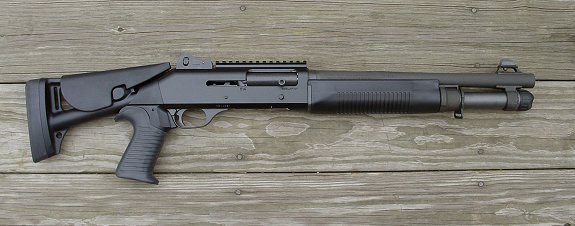
On May 4, 1998, the U.S. Army Armaments Research, Development and Engineering Center (ARDEC) at Picatinny Arsenal, NJ issued Solicitation #DAAE30-98-R-0401, requesting submissions for a new 12 gauge, semi-automatic combat shotgun for the US Armed Services. In response to the request, Benelli Armi SpA of Urbino, Italy designed and built the Benelli M4 Super 90 Combat Shotgun. On August 4, 1998, five samples of the M4 were delivered to Aberdeen Proving Ground, Maryland, and after intense testing, the M4 had beaten the competition. In early 1999, ARDEC awarded the M1014 Joint Service Combat Shotgun contract to Heckler & Koch, USA subsidiary for importation of the Benelli M4 Combat Shotgun. The first units (count of 20,000) were delivered to the United States Marine Corps in 1999. During testing, the prototype was named XM1014, but after adoption, the 'X' was dropped, and the weapon was officially designated the M1014. The M4 was the first gas-operated shotgun produced by Benelli. Its function is designed around an entirely new method called the "auto regulating gas operated" (ARGO) system. The ARGO system on the M4 opened the door for Benelli's development of the R1 rifle line. The design uses two stainless-steel self-cleaning pistons located just ahead of the chamber to function opposite the rotating bolt, thereby eliminating the need for the complex mechanisms found on other gas-actuated automatics. Benelli accomplishes this level of reliability through the simplicity of the mechanism. The ARGO is a short-stroke system that incorporates only four parts. It consists of two symmetrical shrouds containing two small steel gas pistons.
It is also self-regulating for cartridges of varying length and power levels. It can fire 2.75 and 3-inch (76 mm) shells of differing power-levels without any operator adjustments and in any combination. Low-power rounds, such as less-lethal rubber pellets, must be cycled manually.
The sights are military-style ghost ring and are adjustable in the field using only a cartridge rim. The MIL-STD-1913 Picatinny sight rail on top allows use of both conventional and night-vision sights, while retaining use of the original sights.


G36C

Type Assault rifle
Place of origin  Germany
In service 1997–present
Used by 20+ countries (see users)
Wars
  • Kosovo War
  • Afghan War,
  • Iraq War,
  • War in South Ossetia (2008),
  • Operation Banner (PSNI) (Northern Ireland The Troubles)
Designed 1990–1995
Manufacturer Heckler & Koch
Produced 1996–present
Variants See Variants

Weight: 2.82 kg (6.2 lb)

Length G36C: 720 mm (28.3 in) stock extended / 500 mm (19.7 in) stock folded
Barrel length
G36C: 228 mm (9.0 in)
 
Width 64 mm (2.5 in)
Height G36C: 278 mm (10.9 in)


Cartridge 5.56x45mm NATO
Action Gas-operated, rotating bolt
Rate of fire 750 rounds/min cyclic
Muzzle velocity
850 m/s (2,788.7 ft/s)
Effective range 800 metres (870 yd), 200–600 m sight adjustment
Feed system 30-round detachable box magazine or 100-round C-Mag drum magazine
Sights Reflex sight with 1x magnification, telescopic sight with 3x magnification (export version has a 1.5x magnified sight) and back-up fixed notch sight


Work on a successor for the venerable G3 rifle had been ongoing in Germany since the second half of the 1970s. These efforts resulted in the innovative 4.73mm G11 assault rifle (developed jointly by a group of companies led by H&K), that used caseless ammunition (designed by the Dynamit Nobel company). It had been predicted that this weapon would eventually replace the G3, therefore further development of H&K's series of firearms chambered for the 5.56x45mm NATO cartridge had been halted. Heckler & Koch had no incentive to pursue a new 5.56mm weapon system, content with the export-oriented HK33 and G41 rifles. However, the G11 program came to an abrupt end when the Bundeswehr canceled its procurement due to defense budget cuts after the unification of East and West Germany and H&K was acquired in 1991 by British Aerospace's Royal Ordnance division (known today as BAE Systems).
Increasing interest in Germany for a modern service rifle chambered for the NATO-standard 5.56mm cartridge led H&K to offer the German armed forces the G41 rifle, which, too, was rejected. Design work was then initiated from the ground up on a modern 5.56mm assault rifle designated "Project 50" or HK50. The prototype was then trialed, where it was rated higher than the rival Austrian Steyr AUG system. The HK50 rifle was selected for service and an initial order was placed for 33,000 rifles under the Bundeswehr designation Gewehr G36. The order also involved an option for a further 17,000 rifles. Deliveries were first made to the Bundeswehr's NATO Quick Reaction Force during the third quarter of 1997.
In July 1998, it was announced that the G36 had been selected as the standard rifle for the Spanish Armed Forces, replacing the 5.56mm CETME Model L and LC rifles. Deliveries first took place at the end of 1999. These rifles are manufactured in Spain under license by General Dynamics Santa Bárbara Sistemas at the FACOR (Fábrica de Armas de la Coruña) facility, in A Coruña, Galicia.
In addition, the rifle has been licensed for local production in Saudi Arabia.

P90


Type Personal defense weapon
Place of origin Belgium
In service 1991–present
Used by 40+ countries (see Users)
Wars
  • Gulf War
  • Afghanistan War
  • Iraq War
  • Libyan Civil War
Designed 1986–90
Manufacturer FN Herstal
Produced 1990–present
Variants See Variants:
  • P90, P90 TR, P90 USG, P90 LV / IR
  • PS90, PS90 TR, PS90 USG
Weight
  • 2.54 kg (5.60 lb) empty
  • 2.68 kg (5.9 lb) empty magazine
  • 3.0 kg (6.6 lb) loaded magazine
Length 500 mm (19.7 in)
Barrel length 263 mm (10.4 in)
Width 55 mm (2.2 in)
Height 210 mm (8.3 in)
Cartridge FN 5.7×28mm
Action Straight blowback, closed bolt
Rate of fire 900 RPM (rounds per minute)
Muzzle velocity 715 m/s (2,350 ft/s)
Effective range 200 m (219 yd)
Maximum range 1,800 m (1,969 yd)
Feed system 50-round detachable box magazine
Sights Tritium-illuminated reflex sight, back-up iron sights

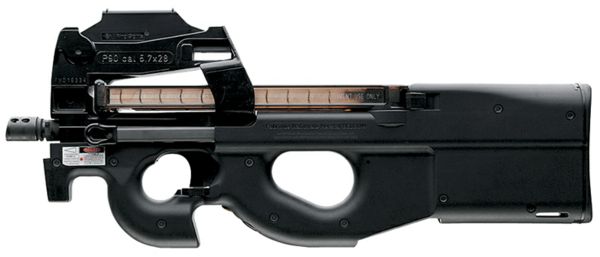
The FN P90 is a selective fire personal defense weapon (PDW) designed and manufactured by FN Herstal in Belgium. The P90's name is taken from 1990, the year it was introduced. The P90 was created in response to NATO requests for a replacement for 9×19mm Parabellum firearms; it was designed as a compact but powerful firearm for vehicle crews, operators of crew-served weapons, support personnel, special forces and counter-terrorist groups.
The P90 was designed by FN in conjunction with the FN Five-seven pistol and 5.7×28mm ammunition. Development of the P90 began in 1986, and production commenced in 1990, whereupon the 5.7×28mm ammunition was redesigned and shortened. A modified version of the P90 with a magazine adapted to use the new ammunition was introduced in 1993, and the Five-seven pistol was subsequently introduced as a companion weapon using the same 5.7×28mm ammunition.
The P90 was developed and initially marketed as a personal defense weapon, but it could also be considered a submachine gun or compact assault rifle. Featuring a compact bullpup design with an integrated reflex sight and fully ambidextrous controls, the P90 is an unconventional weapon with a futuristic appearance. Its design incorporates several innovations such as a unique top-mounted magazine and FN's small caliber, high velocity 5.7×28mm ammunition.
The P90 is currently in service with military and police forces in over 40 countries throughout the world. In the United States, the P90 is in use with over 200 law enforcement agencies, including the U.S. Secret Service.The standard P90 is restricted to military and law enforcement customers, but since 2005, a semi-automatic carbine version has been offered to civilian shooters as the PS90.