Showing posts with label PISTOLS. Show all posts

Thursday, September 22, 2011

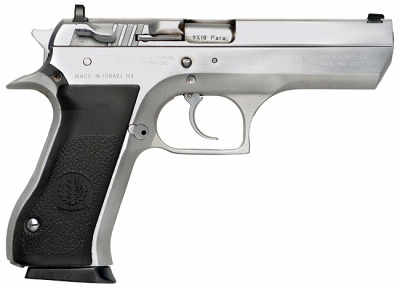
IMI JERICHO 941


Type Semi-automatic pistol
Place of origin  Israel
Manufacturer Israel Weapon Industries
Produced 1990-present
Variants See Variants
Cartridge
  • 9x19mm Parabellum
  • .40 S&W
  • .41 Action Express
  • .45 ACP
Action Short recoil
Feed system 9 or 13 round Detachable box magazine
Sights Fixed (Combat), or optional fully adjustable, or optional illuminated night sights.

The Jericho 941 is a double action/single action semi-automatic pistol developed by Israel Weapon Industries and introduced to the market in 1990 as the Jericho 941. It was first imported into the US in 1990 by K.B.I., Inc. of Harrisburg, PA. It was later imported by O.F. Mossberg & Sons and named the Uzi Eagle and by Magnum Research, Inc. as the Baby Eagle until the end of 2008. Beginning January 1, 2009 until they ceased business on January 29, 2010, K.B.I., Inc. (which also imported Charles Daly firearms) resumed importation of the handgun as the Jericho. Magnum Research, now a division of Kahr Arms, announced a renewed importation of the Jericho.
The original Jericho 941 was based on the well-respected CZ-75 pistol designed and produced by Česká zbrojovka (CZ) of the Czech Republic and built using parts supplied by the Italian arms house Tanfoglio, which had been making their own CZ-75 clones. Using a well-tested design allowed IMI to avoid the teething problems most new pistol designs experience, and subcontracting much of the basic fabrication work to Tanfoglio allowed IMI to quickly and economically put into production a pistol that would have enough Israeli content to satisfy government contract requirements.
While the Jericho 941 features a safety/decocker, the CZ-75 features only a separate de-cocker, with several exceptions. The CZ-75 recommends that the hammer be half-cocked as a safety since the trigger will not pull if this is the case. Since the Jericho 941 has a safety integrated into the de-cocker, a half-cocked Jericho 941 is not safe and will fire. The barrel of the CZ-75 is rifled, while the Jericho 941 features a polygonal barrel, furthermore the Jericho 941 is substantially heavier. These differences translate into substantial differences in the condition in which the gun is carried, and in preference. The two guns are far from identical.
The single most significant innovation attempted by IMI was offering a new, much "hotter" cartridge, the .41 Action Express (see below) to go along with the Jericho 941. The difference between 9MM and .41 AE is the same as .44 magnum and .50 AE. The AE bullets have rebated rims which are the same diameter as the less powerful rounds, but the casing is wider providing more power. This allows these pairs of calibers to be used in the same firearm with only a change of barrel, recoil spring and magazine.
The .41 AE was even less successful in gaining traction in the marketplace than the 10 mm, and was soon discontinued. Experience with heavily loaded rounds gave IMI a considerable lead, however, in chambering for the soon-to-be successful .40 S&W and also allowed the Jericho to "up-chamber" to the very popular .45 ACP.Firearm enthusiasts praise the accuracy of the Jericho/Baby Eagle, its reliability, and its pricing. It is generally considered to be a very slim design for a large caliber pistol with a double-stack magazine, with "natural" pointing due to grip angle.The Jericho 941 design has been modified to include accessory rails on the frame for mounting lasers or weaponlights, a popular feature on many current-generation semi-automatic handguns.

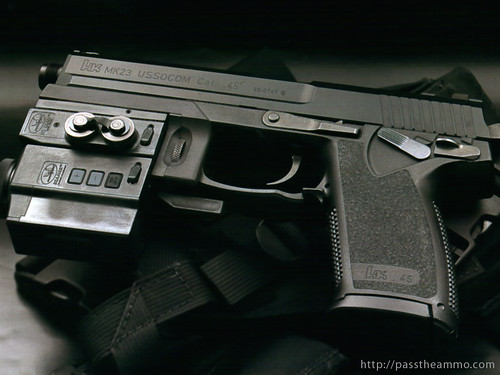
HK MK23


Type Semi-automatic pistol
Place of origin  Germany
 United States
In service 1996-present
Used by See Users
Designed 1990s
Manufacturer Heckler & Koch
Variants
  • MK23 Mod 0 (military markets)
  • Mark 23 (civilian and law enforcment markets)
Weight
  • 1.2 kg (2.7 lb), empty
  • 1.47 kg (3.2 lb), loaded
  • 2.29 kg (5.0 lb), loaded, with suppressor and LAM
Length
  • 245 mm (9.7 in), without suppressor
  • 421 mm (16.5 in), with suppressor
Barrel length 150 mm (5.9 in)
Cartridge .45 ACP
Actio Short recoil, DA/SA
Rate of fire Semi-automatic
Muzzle velocity 260 m/s (850 ft/s)
Effective range 25 m
Feed system Detachable box magazine; capacities:
  • 12 rounds (standard)
  • 10 rounds (restricted)

The Heckler & Koch MK23 is a handgun consisting of a match grade semi-automatic pistol, a laser aiming module (LAM), and suppressor. It was adopted by the United States Special Operations Command (USSOCOM) for special operations units in the 1990s.
While the designation applies to the complete system, it's also commonly used in reference to the pistol component itself. The pistol itself, chambered for the .45 ACP cartridge, was developed by Heckler & Koch, and was selected over the Colt OHWS through USSOCOM's Offensive Handgun Weapon System (OHWS) program. The LAM and suppressor were developed by Insight Technology and Knight's Armament Company (KAC), respectively.
The MK23 Mod 0 was built as an "offensive" handgun for U.S. special operations forces under USSOCOM, as per request made in 1989. Military versions of the firearm have the writing "MK23 USSOCOM" engraved on the slide.
The MK23 is considered a match grade pistol, and is capable of making a 2-inch (51 mm) group at 50 yards (46 m), roughly 4 MOA. Production began in 1991, and it was the basis for the HK USP, which began production in 1993. The MK23 has exceptional durability in harsh environments, being waterproof and corrosion-resistant. It uses a polygonal barrel design, which is reported to improve accuracy and durability. It also features an ambidextrous safety and magazine release on both sides of the frame. The magazine release is at the rear edge of the trigger guard, which is wide enough to allow the use of gloves. A decocking lever is on the left side, which will silently lower the cocked hammer. The MK23 is part of a larger weapon system that includes an attachable laser aiming module, a suppressor, and some other features such as a special high-pressure match cartridge (.45 +P ammunition).
The firearm was tested and found to be capable of firing tens of thousands of rounds without a barrel change. It remains reliable in harsh conditions, making it suitable for use by special forces. The .45 ACP round has considerable stopping power, and yet is subsonic making it suitable for use with a suppressor. Additionally, its shared design characteristics with the Colt M1911 pistol have made it easy for people who have experience with a 1911 to field strip and properly clean the MK23.
However, the firearm's large size and weight have resulted in some criticism. In response, HK developed the USP Tactical pistol based on the original USP; the Tactical retains much of the performance of the MK23 without the bulky size. It uses a different suppressor (due to left handed threading, as opposed to right-handed on the Mk23). An even more compact pistol than the USP Tactical for counter-terrorist and special forces use is the new HK USP Compact Tactical, which also has its own optional LAM. The USP-CT is lighter and is also capable of fitting a suppressor, making it a prime choice for Special Forces on covert operations.
The proposed Joint Combat Pistol (JCP) was intended to accept match grade and +P ammunition. However, it is not clear if the JCP, which absorbed the earlier SOF Combat Program, will be used alongside or replace the MK23 handguns. As of 2006, the JCP has since been renamed and restructured.


Wednesday, September 21, 2011

S&W MP


Type Semi-automatic pistol
Place of origin  United States
Manufacturer Smith & Wesson
Produced 2005–present
Variants
  • M&P Pro Series
  • M&P9L
  • MP9 JG
  • M&Pc (Compact Size)
Barrel length 108 mm
Cartridge
  • 9x19mm Parabellum (MP 9)
  • .40 S&W (MP 40)
  • .357 SIG
  • .45 ACP (MP 45)
Action Short recoil, locked breech
Muzzle velocity 370 m/s (1,214 ft/s)
Effective range 50 m (55 yd)
Feed system detachable box magazine
Sights Steel ramp dovetail (front), steel Novak LoMount Carry (rear)

The Smith & Wesson M&P (Military and Police) is a polymer-framed, short recoil operated, locked breech semi-automatic pistol introduced in the summer of 2005 by the American company Smith & Wesson. It uses a Browning-type locking system. While targeted at law enforcement agencies, the M&P is also available on the commercial market.
The M&P is a striker fired semi-automatic pistol. This trigger system prevents the firearm from discharging unless the trigger is fully depressed, even if the pistol is dropped. An internal lock and/or magazine disconnect are available as options and an optional external thumb safety became available in 2009.
The pistol frame is made out of Zytel polymer reinforced with a stainless steel chassis. The slide and barrel are made out of stainless steel that after through hardening is treated with a proprietary nitriding process called Melonite. The Melonite process produces a matte gray-colored, non-glare surface with a 68 Rockwell C surface hardness rating. The pistol has a very low slide profile which holds the barrel axis close to the shooter's hand and makes the M&P more comfortable to shoot by reducing muzzle rise and allowing for faster aim recovery in rapid shooting sequence. The slide has four contact points with the frame. This was done to make the rail system self cleaning, by leaving room for any dirt or small foreign objects to fall out of the weapon.
As the slide of the pistol enters battery, the striker engages the sear. At this point, the sear is held back in a partially cocked condition. When the trigger of the M&P is pulled, the trigger bar first engages the firing pin safety plunger, lifting it upward, and releasing firing pin safety. At the rearward extreme of the trigger bar's travel, it engages the sear. The sear is rotated downward by the trigger bar, fully cocking, then releasing the striker. The striker makes contact with the primer of the chambered round, which in turn ignites the gunpowder and propels the bullet forward. According to renowned M&P gunsmith Dan Burwell, the angle on the rear face of the sear creates a caming action against the striker. This caming action moves the striker to the rear very slightly during the trigger pull, thus finishing the "cocking". This system is similar to the partially tensioned striker found in the Glock series of pistols. When the pistol cycles for the next shot, the striker will be automatically pre-set in a 98% cocked position. Because the striker is only 98% cocked prior to the trigger being pulled, Smith and Wesson classifies the M&P's action as "striker fired (double action only)".
The M&P factory trigger is of the jointed type and has a trigger travel of 7.6 mm (0.3 in) and is rated at 29 N (6.5 lbf). The M&P45c models have a slightly higher rated trigger pull of 31 N (7.0 lbf). The competition oriented M&P40 Pro Series 5" have a reduced trigger pull of 20 N (4.5 lbf) due to the installation of a Smith and Wesson performance center sear. MA approved models have a trigger pull of 45 N. 
Several safety features are prominent on the M&P. A sear deactivation lever permits the shooter to disassemble the pistol without having to pull the trigger to accomplish disassembly. The pistol also has a loaded chamber indicator viewing opening on top of the slide.
Ergonomics were a key focus in the design of the firearm, and as a result, three interchangeable palm swell grips are included (small, medium and large). The trigger guard is designed to accommodate gloves. The frame of the M&P has a slide release lever on each side. The magazine drops free when the magazine release is pressed. The firearm features an ambidextrous slide stop and reversible magazine release for either right or left hand operation.
The pistols are delivered with 2 magazines.
The standard iron sights are of the three dot type and made of steel. Both the front and rear sights are dove-tailed into the slide, and can be horizontally drifted to adjust for windage correction.
An integrated Picatinny rail can be found underneath the slide on the front of the frame for attaching tactical lights, lasers and other accessories.


Monday, September 19, 2011

HK USP


Type Pistol
Place of origin  Germany
Designer Helmut Weldle
Designed 1989–1992
Manufacturer Heckler & Koch
Produced 1993–present
Variants See Variants

Weight Without magazine:

  • 748 g (1.65 lb) (USP 9 mm/.40)
  • 789 g (1.74 lb) (USP .45)
Length
  • 194 mm (7.64 in) (USP 9 mm/.40)
  • 200 mm (7.87 in) (USP .45)
Barrel length
  • 108 mm (4.25 in) (USP 9 mm/.40)
  • 112 mm (4.41 in) (USP .45)
Cartridge
  • 9x19mm Parabellum
  • .40 S&W
  • .45 ACP
Action Short recoil, DA/SA, DA/DAO
Rate of fire Semi-automatic
Effective range 50 m (9x19mm Parabellum), 30 m (.45 ACP)
Feed system Detachable box magazine; capacities:
USP:
  • 15 rounds (9 mm Para)
  • 13 rounds (.40 S&W)
  • 12 rounds (.45 ACP)

Design work on a new family of pistols commenced in September 1989 focused primarily on the U.S. commercial and law enforcement markets. In 1991, USP prototypes participated in rigorous testing alongside H&K's entry in the OHWS (Offensive Handgun Weapon System) program requested by the U.S. Special Operations Command (USSOCOM) and which would later result in the Mk 23 Mod 0. The USP prototypes were then refined in 1992, based on input from the OHWS trials and the design was finalized in December of the same year. The USP was formally introduced in January 1993 with the USP40 model (the base version) chambered for the increasingly popular .40 S&W cartridge, followed soon by the USP9 (using the 9x19mm Parabellum cartridge), and in May 1995—the USP45 (caliber .45 ACP).
The USP marked the first time H&K chose to incorporate many traditional handgun design elements, such as those of John Browning's M1911, in one pistol. Two principles guided its development—the first being the use of a molded polymer frame, and the second being the creation of a "pistol paradigm". Heckler & Koch observed the strong points of its previous successful pistols for insight in developing the USP. Previous H&K pistol innovations include the unique squeeze-cocking mechanism of the P7, the precise roller-delayed blowback operation of the P9S, and the plastic frame and double action only trigger system used in the VP70Z. In contrast to these ambitious designs, the USP uses a Browning-style cam-locked action, similar to that developed by John Browning for use in the Hi-Power and M1911 pistols.


Wednesday, September 14, 2011

BERETTA PX4 STORM SPECIAL DUTY


Type Semi-automatic pistol
Place of origin  Italy
Manufacturer Beretta
Produced 2004–present
Variants C, D, F, G, SC
Weight Px4: 785 g (27.7 oz) (without magazine)
Px4SC: 715 g (25.2 oz) (without magazine)
Length Px4: 192 mm (7.55 in)
Px4SC: 158 mm (6.2 inch)
Barrel length 102 mm (4.0 in)
Cartridge 9x19mm Parabellum, .40 S&W, .45 ACP,
Action Short recoil, locked-breech, rotating barrel lock
Muzzle velocity 360 m/s (1,181 ft/s) (9x19mm Parabellum)
Effective range
  • 50 m (164 ft) (9x19mm Parabellum)
  • 25 m (82 ft) (.40 S&W and .45 ACP)
Feed system Px4: 10, 14, 17 or 20 round box magazine
Px4SC: 13 (9mm) or 10 (.40 S&W) box magazine
Sights 3-dot luminescent

The new Beretta Px4 Storm SD .45 (Special Duty) pistol is the most advanced sidearm of its kind, bar none. Designed to meet the rigorous specifications of S.O.C.O.M., the Px4 Storm SD .45 provides maximum firepower in any environmental and special duty situation.
Built around Beretta’s latest Px4 Storm modular technology, the Px4 Storm SD .45 includes the same features as the standard .45 — along with various materials and finishes capable of withstanding the toughest military applications.
An optimal grip angle ensures a correct line of sight and contoured to snugly fit the shooter’s hand. Part of a newly patented modular system, the pistol adapts to different hand sizes easily with interchangeable backstraps (included). An ambidextrous manual safety lever is positioned on both sides of the slide for easy access by all shooters. A reversible magazine release button can be mounted on either side and can quickly be
replaced by a smaller and larger size button. An interchangeable slide catch can also be replaced with an optional low profile configuration. A standard Picatinny Rail (MIL-STD-1913) allows for an array of aftermarket accessories.


KEL-TEC PMR30


The PMR-30 is a light weight, full size pistol chambered for the flat-shooting .22Magnum cartridge (.22WMR). The PMR-30 operates on a unique hybrid blowback/locked-breech system. This operation system allows for the use of a wide variety of ammunition as it seamlessly adjusts between locked breach and blowback operation, depending on the pressure of the cartridge. It uses a double stack magazine of a new design that holds 30 rounds and fits completely in the grip of the pistol. The trigger is a crisp single action with an over-travel stop. The manual safety is a thumb activated ambidextrous safety lever (up for SAFE, down for FIRE). The slide locks back after the last shot and a manual slide lock lever is also provided. The light, crisp trigger pull and fiber optic sights make the PMR-30 ideal for target shooting and hunting small game.