WELCOME -
BIENVENUE -
WILLKOMMEN -
BIENVENIDOS -
BENVENUTI -
NEW ITALIAN BLOG ON THE NEW MILITARY WEAPONS AROUND THE WORLD. CLICK ON OLDER POSTS, OR CHECK THE LIST AT THE RIGHT TO SE HOW MANY WEAPONS WE HAVE POSTED. THANKS FOR VISITING.
4+1 (civilian) or 6+1 (Military, LE) internal tube magazine
Sights
Ghost ring sight
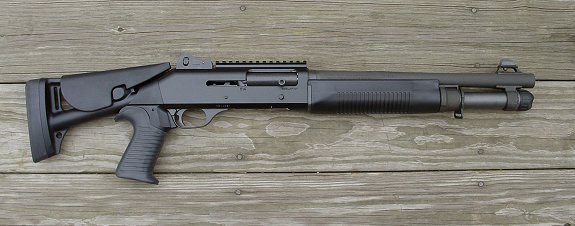
On May 4, 1998, the U.S. Army Armaments Research, Development and Engineering Center (ARDEC) at Picatinny Arsenal, NJ issued Solicitation #DAAE30-98-R-0401, requesting submissions for a new 12 gauge, semi-automatic combat shotgun for the US Armed Services. In response to the request, Benelli Armi SpA of Urbino, Italy designed and built the Benelli M4 Super 90 Combat Shotgun. On August 4, 1998, five samples of the M4 were delivered to Aberdeen Proving Ground, Maryland, and after intense testing, the M4 had beaten the competition. In early 1999, ARDEC awarded the M1014 Joint Service Combat Shotgun contract to Heckler & Koch, USA subsidiary for importation of the Benelli M4 Combat Shotgun. The first units (count of 20,000) were delivered to the United States Marine Corps in 1999. During testing, the prototype was named XM1014, but after adoption, the 'X' was dropped, and the weapon was officially designated the M1014. The M4 was the first gas-operated shotgun produced by Benelli. Its function is designed around an entirely new method called the "auto regulating gas operated" (ARGO) system. The ARGO system on the M4 opened the door for Benelli's development of the R1 rifle line. The design uses two stainless-steel self-cleaning pistons located just ahead of the chamber to function opposite the rotating bolt, thereby eliminating the need for the complex mechanisms found on other gas-actuated automatics. Benelli accomplishes this level of reliability through the simplicity of the mechanism. The ARGO is a short-stroke system that incorporates only four parts. It consists of two symmetrical shrouds containing two small steel gas pistons.
It is also self-regulating for cartridges of varying length and power levels. It can fire 2.75 and 3-inch (76 mm) shells of differing power-levels without any operator adjustments and in any combination. Low-power rounds, such as less-lethal rubber pellets, must be cycled manually.
The sights are military-style ghost ring and are adjustable in the field using only a cartridge rim. The MIL-STD-1913 Picatinny sight rail on top allows use of both conventional and night-vision sights, while retaining use of the original sights.
Kel-Tec will release the pump-action KSG (Kel-Tec Shotgun) that features dual magazine tubes that can accomodate 14 rounds, the company announced.
The weapon is similar to the currently available Kel-Tec RFB rifle. As one difference, the KSG ejects casings downward rather than forward. The KSG weighs 6.9 pounds and is as compact as legally possible with a 26.1-inch overall length and an 18.5-inch cylinder bore barrel.
The internal dual tube magazines hold 14 rounds of 12 gauge 2-3/4-inch shotshells (7 per tube). The pump action feeds from either the left or right tube.
The feed side is manually selected by a lever located behind the trigger guard. The lever can be positioned in the center detent in order to easily clear the chamber without feeding another round from either magazine. A cross bolt-style safety blocks the sear, and the pump-release lever is located in front of the trigger guard.
The pump includes an under-Picatinny rail for the mounting of a forward grip, light or laser. The included top Picatinny sight rail will accept many types of optics or iron sights. Forward and rear sling loops are built in, and a basic sling is included. The soft rubber butt pad helps to tame recoil.
 Italy
Italy

