Showing posts with label BATTLE/ASSOULT RIFLE. Show all posts

Thursday, September 22, 2011

AK 107/8


Type Assault rifle
Place of origin  Russia
Designer Youriy K. Alexandrov
Designed 1994
Manufacturer Izhmash
Variants AK-108
Weight 3.8 kg (8.38 lb)
Length 943 mm (37.1 in) stock extended / 700 mm (27.6 in) stock folded
Barrel length 415 mm (16.3 in)
Cartridge 5.45x39mm (AK-107)
5.56x45mm NATO (AK-108)
Action Gas-operated, rotating bolt, BARS system
Rate of fire 850 rounds/min (AK-107)
900 rounds/min (AK-108)
Muzzle velocity 900 m/s (2,953 ft/s) (AK-107)
910 m/s (2,985.6 ft/s) (AK-108)
Effective range 500 m
Feed system 30-round detachable box magazine
60 round AK-74 compatible casket magazines
Sights Protected front post, rear V-notch on tangent

The AK-107 is a Russian 5.45 mm assault rifle developed from the AK-100-series. It features a "balanced" operating system, similar to that used in the AEK-971. In this case, the designation AK does not indicate Avtomat Kalashnikova but Alexandrov/Kalashnikov. The revised designation indicates the incorporation of a new gas system, designed by Youriy Alexandrov, for Kalashnikov-pattern rifles.
These new rifles were derived from the AL-7 experimental rifle of the early 1970s. The AL-7 utilized an innovative balanced gas operating system known as the Balanced Automatics Recoil System (BARS) developed by Peter Andreevich Tkachev of TsNIITochMash that was first used earlier on the AO-38 assault rifle of 1965 that essentially eliminated felt recoil and muzzle rise. The system was modified by Alexandrov, then a junior engineer at Izhmash, and prototypes were produced under the designation AL-7. The AL-7 was considered too expensive for production at the time and the Soviet Army selected the AK-74 instead as the new service rifle. No further development occurred until the mid-1990s when Alexandrov, by then a senior engineer, was directed to update his design for production as a less expensive alternative to the AN-94. The new rifle differs only slightly from the original AL-7. The AK-107 receiver is not fluted and a three-round burst feature has been added. There is otherwise little difference between it and the AL-7 prototypes. The AK-107 and AK-108 represent a significant change to the Kalashnikov operating system originally designed in the late 1940s. The new rifle features a balanced system that functions along the lines of Newton's third law of motion, which states that for every action there is an equal and opposite reaction. This system uses a recoil-reducing countermass mechanism with two operating rods that move in opposite directions, thereby providing "balance". One operating rod, the upper, has a gas piston facing forward while the also has a gas piston. The gas tube at the forward end of the handguard is double-ended to accommodate the two rods. The enlarged gas tube cover of the upper handguard guides both rods in their travel.


FAMAS G2


Type Assault rifle
Place of origin  France
In service 1978–present
Used by See Users
Wars
  • 1982 Lebanon War
  • Chadian–Libyan conflict
  • Gulf War
  • Bosnian War
  • Afghanistan war
Designer Paul Tellie
Designed 1971
Manufacturer Nexter


Produced 1975–2000

Variants F1
G1
G2
FAMAS Export
FAMAS Civil
FAMAS Commando

Weight
3.8 kg (8.4 lb) (FAMAS G2)
Length 757 mm (29.8 in) / 965 mm (38.0 in) with bayonet
Barrel length F1, G2: 488 mm (19.2 in)


Cartridge 5.56x45mm NATO
Action Lever-delayed blowback
Rate of fire
1000–1100 rounds/min (G2)
Muzzle velocity
925 m/s (3,030 ft/s) (G2)
Effective range
450 m
Maximum range 3200 metres
Feed system
30-round box magazine (STANAG system)
Sights Rear aperture fitted with tritium night inserts, front post


The first French bullpup rifles were developed between 1946 and 1950 at the AME (Atelier Mécanique de Mulhouse) and MAS, testing rounds such as .30 US Carbine, 7.92x33mm Kurz, 7.65x38mm (Made by Cartoucherie de Valence) and some other intermediate calibers. Since France was engaged in the First Indochina War at the time, and was also the second-largest contributor to NATO, the budgets for new types of weapons were reduced and priority was given to the modernisation and production of existing service weapons. Nevertheless, approximately forty different prototypes were developed between 1952 and 1962, most of which were designed for the 7.62x51mm NATO round notably the FA-MAS Type 62 (the bayonet of which is used on the FAMAS). However the round was not found to be suitable for any bullpup designs, and consequently, none were adopted, and the ideas were set aside. MAS then began to manufacture under licence the H&K G3 and the H&K 33 in the 1960s and studies were reactivated to produce a weapon using the new .223/5.56mm round. But the idea to develop and use German weapons was out of question for many members of the French high command. General Marcel Bigeard, against the idea to use German weapons, visited the Manufacture d'Armes de Saint-Étienne and asked the engineers to present him the different prototypes developed. He then chose, amongst different prototypes, what would become the FAMAS.
The FAMAS project began in 1967 under the direction of Paul Tellie and the first prototype was completed in 1971, with French military evaluation of the rifle beginning in 1972. When production problems delayed the general issue of the new rifles, and with the 1978 Battle of Kolwezi showing the immediate need for a more modern weapon, the French Army began searching for a temporary rifle to fill this need until the FAMAS came into full production. The H&K 33 was considered, and a batch of 1200 examples were tested by Infantry, Airborne, Marines, Mechanised and Foreign troops, but it was ultimately turned down in favour of the SIG SG 540, built under licence by Manurhin, until enough FAMAS rifles were produced to begin general issue. The French military finally accepted the rifle in 1978 as the standard French combat weapon.
After adoption, the FAMAS F1 replaced the aging MAS 49/56 rifle and MAT-49 submachine gun, and approximately 400,000 FAMAS F1 assault rifles were produced, with production now complete. The F1 had many problems and was not completely reliable. For instance, the plastic pieces broke easily and the weapon jammed on occasions because of the poor disposable magazine concept. The first magazines were supposed to be disposables, but the budget of the French army never allowed it. The F1 was followed by the G1 that included several minor improvements such as redesigned grips, Magwell compatible with STANAG & FAMAS magazine and an enlarged trigger guard, but it remained conceptual and was never actually produced.

Wednesday, September 21, 2011

G36C

Type Assault rifle
Place of origin  Germany
In service 1997–present
Used by 20+ countries (see users)
Wars
  • Kosovo War
  • Afghan War,
  • Iraq War,
  • War in South Ossetia (2008),
  • Operation Banner (PSNI) (Northern Ireland The Troubles)
Designed 1990–1995
Manufacturer Heckler & Koch
Produced 1996–present
Variants See Variants

Weight: 2.82 kg (6.2 lb)

Length G36C: 720 mm (28.3 in) stock extended / 500 mm (19.7 in) stock folded
Barrel length
G36C: 228 mm (9.0 in)
 
Width 64 mm (2.5 in)
Height G36C: 278 mm (10.9 in)


Cartridge 5.56x45mm NATO
Action Gas-operated, rotating bolt
Rate of fire 750 rounds/min cyclic
Muzzle velocity
850 m/s (2,788.7 ft/s)
Effective range 800 metres (870 yd), 200–600 m sight adjustment
Feed system 30-round detachable box magazine or 100-round C-Mag drum magazine
Sights Reflex sight with 1x magnification, telescopic sight with 3x magnification (export version has a 1.5x magnified sight) and back-up fixed notch sight


Work on a successor for the venerable G3 rifle had been ongoing in Germany since the second half of the 1970s. These efforts resulted in the innovative 4.73mm G11 assault rifle (developed jointly by a group of companies led by H&K), that used caseless ammunition (designed by the Dynamit Nobel company). It had been predicted that this weapon would eventually replace the G3, therefore further development of H&K's series of firearms chambered for the 5.56x45mm NATO cartridge had been halted. Heckler & Koch had no incentive to pursue a new 5.56mm weapon system, content with the export-oriented HK33 and G41 rifles. However, the G11 program came to an abrupt end when the Bundeswehr canceled its procurement due to defense budget cuts after the unification of East and West Germany and H&K was acquired in 1991 by British Aerospace's Royal Ordnance division (known today as BAE Systems).
Increasing interest in Germany for a modern service rifle chambered for the NATO-standard 5.56mm cartridge led H&K to offer the German armed forces the G41 rifle, which, too, was rejected. Design work was then initiated from the ground up on a modern 5.56mm assault rifle designated "Project 50" or HK50. The prototype was then trialed, where it was rated higher than the rival Austrian Steyr AUG system. The HK50 rifle was selected for service and an initial order was placed for 33,000 rifles under the Bundeswehr designation Gewehr G36. The order also involved an option for a further 17,000 rifles. Deliveries were first made to the Bundeswehr's NATO Quick Reaction Force during the third quarter of 1997.
In July 1998, it was announced that the G36 had been selected as the standard rifle for the Spanish Armed Forces, replacing the 5.56mm CETME Model L and LC rifles. Deliveries first took place at the end of 1999. These rifles are manufactured in Spain under license by General Dynamics Santa Bárbara Sistemas at the FACOR (Fábrica de Armas de la Coruña) facility, in A Coruña, Galicia.
In addition, the rifle has been licensed for local production in Saudi Arabia.

Monday, September 19, 2011

M4 BEOWOLF

Type Rifle
Place of origin United States
Designed 2001
Produced 2001
Parent case .50 Action Express
Case type Rebated rim, straight
Bullet diameter .500 in (12.7 mm)
Neck diameter .525 in (13.3 mm)
Base diameter .535 in (13.6 mm)
Rim diameter .445 in (11.3 mm)
Case length 1.65 in (42 mm)
Overall length 2.125 in (54.0 mm)
Primer type Large pistol magnum

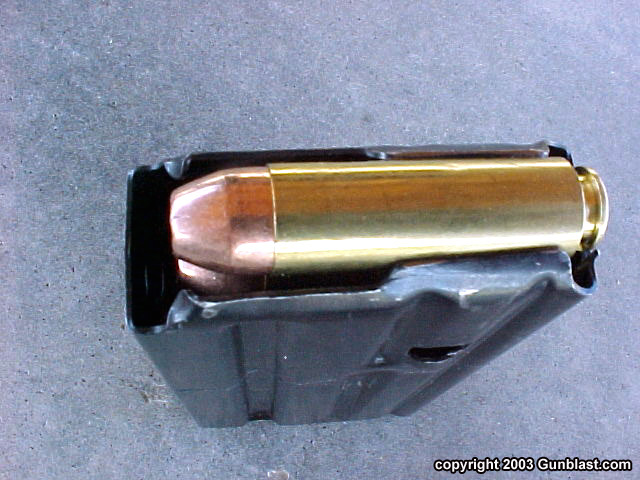
The .50 Beowulf [12.7 x 42 mm Rb] is a rifle cartridge developed by Alexander Arms for use in a modified AR-15 rifle. The cartridge utilizes a rebated rim, sized to match the rim of the 7.62x39mm and 6.5 mm Grendel rounds. It is very similar in dimensions to the .500 S&W Magnum revolver cartridge.
According to the manufacturer, it was descended from the .50 Action Express, a cartridge originally developed for the Magnum Research Desert Eagle pistol, with significant modification to improve functionality and safety in the AR-15 platform.
The round is intended to improve stopping power greatly at short-to-medium range as compared to the standard 5.56mm. One of its advertised uses is at vehicle checkpoints, since the heavy bullet's flight path is not easily deflected by auto glass or standard vehicle body panels.


HK 417


Type Battle rifle
Place of origin  Germany
Designer Heckler & Koch
Manufacturer Heckler & Koch
Variants Assaulter (12" barrel - standard)
Recce (16" barrel - standard and accurized)
Sniper (20" barrel - accurized)

Weight 3.87 kg [8.5 lbs] (12 inch barrel),
4.05 kg [8.9 lbs] (16 inch barrel),
4.23kg [9.3lbs] (20 inch barrel)
Length 805 / 885 mm (12" barrel, stock collapsed/extended),
905 / 985 mm (16" barrel, stock collapsed/extended),
1005 / 1085 mm (20" barrel, stock collapsed/extended)
Barrel length 305 mm (12 in) standard
406 mm (16 in) standard
406 mm (16 in) accurized
508 mm (20 in) accurized
Cartridge 7.62x51mm NATO
Action Gas-operated, rotating bolt
Rate of fire 600 rounds/min
Muzzle velocity 709 m/s (12 in)
750 m/s (16 in)
789 m/s (20 in)
Feed system 10 or 20 round detachable box magazine Optional 50 round drum magazine
Sights accessory diopter/rotary or optics


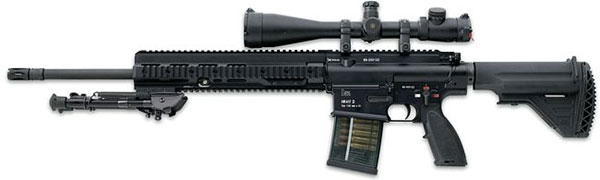
The HK417 is a battle rifle designed and manufactured in Germany by Heckler & Koch. It is a gas-operated, selective fire rifle with a rotating bolt and is essentially an enlarged HK416. Chambered for the 7.62x51mm NATO round, it is intended for use as a designated marksman rifle, and in other roles where the greater penetrative power and range of the 7.62mm round are required. It has been adopted for service by a number of armed forces, special forces, and police organizations.
The HK417 is similar in internal design to the HK416, but the receiver and working parts are enlarged to suit the larger 7.62mm round. The bolt is a 7-lug rotating type, which sits in a bolt carrier and operates in a forged alloy receiver resembling those of the Stoner-designed AR-10, AR-15 and M16 series weapons. Like the HK416, the HK417 is a gas-operated, with a short-stroke piston design similar to those found in the HK416, G36 and ArmaLite AR-18. The short-stroke piston is claimed to be more reliable than the original direct impingement operation of the AR-10 and AR-15 designs because, unlike these weapons, it does not vent propellant gases directly into the receiver, which deposits carbon fouling onto the bolt mechanism and is thought to induce malfunctions.
The early prototype HK417 used 20-round magazines from the H&K G3 rifle family, which did not feature a bolt hold-open device. Later prototypes, however, switched to a polymer magazine with bolt hold-open. The magazine resembles an enlarged version of the G36 series transparent magazine, except without the pins for holding more than one magazine together. In addition, a well proven 50-round, low profile drum magazine developed by HK for the HK21E machine gun can be fitted to the HK417 for use in support and sustained fire applications.
The HK417 is designed more for use as a "designated marksman" rifle than an assault rifle, with its increased cost, accuracy, penetrative power and effective range weighed against decreased rate of fire and magazine capacity (although fully automatic fire is selectable).
The HK417 is currently only available to government and military organizations.


SCAR-L AND SCAR-H


Type Assault rifle (SCAR-L)
Battle rifle (SCAR-H)
Place of origin  Belgium
 United States
In service 2009-present
Used by See Users
Wars Afghanistan War
Manufacturer FNH USA
Variants
  • SCAR-L (Mk 16 Mod 0)
  • SCAR-H (Mk 17 Mod 0)
Weight 3.04 kg (6.7 lb) (SCAR-L Short) 3.29 kg (7.3 lb) (SCAR-L Standard)
3.49 kg (7.7 lb) (SCAR-L Long)
3.58 kg (7.9 lb) (SCAR-H Short & Standard)
3.72 kg (8.2 lb) (SCAR-H Long)
Barrel length 254 mm (10.0 in) (SCAR-L Short) 368 mm (14.5 in) (SCAR-L Standard)
457 mm (18.0 in) (SCAR-L Long)
330 mm (13 in) (SCAR-H Short)
400 mm (16 in) (SCAR-H Standard)
500 mm (20 in) (SCAR-H Long)
Cartridge
  • 5.56x45mm NATO (SCAR-L)
  • 7.62x51mm NATO, 7.62x39mm M43 (SCAR-H)
Action Gas-operated, rotating bolt
Rate of fire 625 rounds/min
Muzzle velocity
  • SCAR-L: 2,870 ft/s (870 m/s) (M855)
  • SCAR-L: 2,630 ft/s (800 m/s) (Mk 262)
  • SCAR-H: 2,342 ft/s (714 m/s) (M80)
Effective range SCAR-L: 300 metres (330 yd) (Short), 500 metres (550 yd) (Standard), 600 metres (660 yd) (Long)
SCAR-H: 300 metres (330 yd) (Short), 600 metres (660 yd) (Standard), 800 metres (870 yd) (Long)
Feed system
  • SCAR-L: STANAG box magazine
  • SCAR-H: 20-round box magazine
Sights Iron or various optics


The Special Operations Forces (SOF) Combat Assault Rifle, or SCAR, is a modular rifle made by FN Herstal (FNH) for the United States Special Operations Command (SOCOM) to satisfy the requirements of the SCAR competition. This family of rifles consist of two main types. The SCAR-L, for light, is chambered in the 5.56x45mm NATO cartridge and the SCAR-H, for heavy, fires 7.62x51mm NATO. Both are available in Long Barrel and Close Quarters Combat variants.
The FN SCAR systems completed low rate initial production testing in June 2007.After some delays, the first rifles began being issued to operational units in April 2009, and a battalion of the US 75th Ranger Regiment was the first large unit deployed into combat with 600 of the rifles in 2009. The US Special Operations Command has currently cancelled their purchase of the Mk 16 SCAR-L and are planning to remove the rifle from their inventory by the year 2013. However, they plan to purchase 5.56 conversion kits for the Mk 17, supplanting the loss of the Mk 16.
he SCAR is manufactured in two main versions; Light (SCAR-L, Mk 16 Mod 0) and Heavy (SCAR-H, Mk 17 Mod 0). The L version fires 5.56x45mm NATO using improved STANAG (M16) magazines. The H fires the more powerful 7.62x51mm NATO from a newly designed 20-round magazine. Different length barrels will be available for close quarters battle and for longer-range engagements. The initial solicitation indicated that the SCAR-H would also be chambered for the 7.62x39mm M43 Kalashnikov cartridge and 6.8x43mm Remington SPC cartridge. However, FN is not currently offering other calibers.
The Mk 20 Sniper Support Rifle is based on the 7.62mm Mk 17 rifle. It includes a longer receiver, a beefed up barrel extension and barrel profile to reduce whip and improve accuracy and an enhanced modular trigger that can be configured for single-stage or two-stage operation together with a non folding precision stock.
The Mk 16 Mod 0 was intended to replace the M4A1, the Mk 18 CQBR and the Mk 12 SPR currently in SOCOM service, before SOCOM decided to cancel the order for the Mk 16 Mod 0 (see below). The Mk 17 Mod 0 will replace the M14 and Mk 11 sniper rifles.
The SCAR features an integral, uninterrupted Picatinny rail on the top of the aluminum receiver, two removable side rails and a bottom one that can mount any MIL-STD-1913 compliant accessories. It has a polymer lower receiver with an M16 compatible pistol grip, flared magazine well, and raised area around magazine and bolt release buttons. The front sight flips down for unobstructed use of optics and accessories. The rifle uses a 'tappet' type of closed gas system much like the M1 Carbine while the bolt carrier otherwise resembles the Stoner 63 or Heckler & Koch G36.
The SCAR is built at the FN Manufacturing LLC, plant in Columbia, South Carolina, United States. Fabrique Nationale introduced a semi-automatic version of the SCAR modular rifle system, the 16S (Light) and 17S (Heavy), at the end of 2008. This version of the SCAR is designed for the law enforcement and commercial markets, and is manufactured in Herstal, Belgium and imported by FNH USA, Fredricksburg, Virginia, United States. FNH USA slightly modifies the rifle (supplying a U.S. made magazine and machining a pin in the magazine well) to be in compliance with U.S. Code before selling them.


Saturday, September 17, 2011

HK 416 C


Type Compat Assault Rifle/CQB
Place of origin  Germany

Designer Ernst Mauch
Manufacturer Heckler & Koch
Produced 2010–present
Width 78 mm (3.1 in)
Height HK416C: 236 mm (9.3 in)
Barrel length HK416C: 228 mm (9.0 in)
Length HK416C: 690 mm (27.2 in) stock extended / 560 mm (22.0 in) stock collapsed
Weight HK416C: 2.950 kg (6.50 lb)
Cartridge 5.56x45mm NATO
Action Gas-operated, rotating bolt
Rate of fire 700-900 rounds/min (cyclic)
Muzzle velocity Varies by barrel length and type of round used.
Feed system 20, 30-round STANAG magazine or 100-round Beta C-Mag
Sights Rear rotary diopter sight and front post, Picatinny rail

The HK416C ultra compact variant of the HK416 has been introduced in October 2010. The HK416C has a high degree of component commonality with the HK416 family though the HK416C has a new retractable butt stock and buffer system. According to its specifications the HK416C, with its very short 228 mm (9.0 in) barrel for the 5.56x45mm NATO chambering, can be expected to produce muzzle velocities of approximately 730 m/s (2,395 ft/s). The firearm's precision is specified as ≈ 4 MOA (12 cm at 100 m) by Heckler & Koch. The philosophy behind the ultra compact HK416C variant has similarities with the Heckler & Koch G36C subcarbine, which was developed out of the G36 assault rifle, and the XM8 Compact Carbine design. The intended purpose of subcarbines is to provide operators with a weapon of (nearly) submachine gun or personal defense weapon size, but firing standard military rifle cartridges, for scenarios such as VIP protection, urban warfare, and other close quarters battle (CQB) situations.


Friday, September 16, 2011

QBZ/TYPE 95


Type Assault rifle
Place of origin  People's Republic of China

In service 1997-Present
Used by See Users
Wars Sri Lankan Civil War
Cambodian–Thai border stand-off

Manufacturer China North Industries Corporation
and China South
Produced 1995—present
Variants QBZ-95B Carbine,
QBZ-95 Rifle,
QBB-95 LSW,
 Weight 2.9 kg (6.4 lb) (QBZ-95B
 Length 609 mm (24.0 in) (QBZ-95B
 Barrel length 369 mm (14.5 in) (QBZ-95B


Cartridge 5.8x42mm DBP87 (QBZ-95),
5.56x45mm NATO (QBZ-97)
Action Gas-Operated, Rotating bolt
Rate of fire ~650 rounds/min (QBZ-95)
~800 rounds/min (QBZ-95B Carbine)
Muzzle velocity QBZ-95 - 930 m/s (3,050 ft/s), QBB-95 - 970 m/s (3181 ft/s), QBZ-95B - 790 m/s (2581 ft/s)
Effective range Rifle - 400m point target, 600m area target
LSW - 600m point target, 800m area target
Carbine - 300m point target, 500m area target
Feed system 30-round box magazine
75-round drum
Sights hooded post front sight and aperture rear sight, optional 4x telescopic sigh


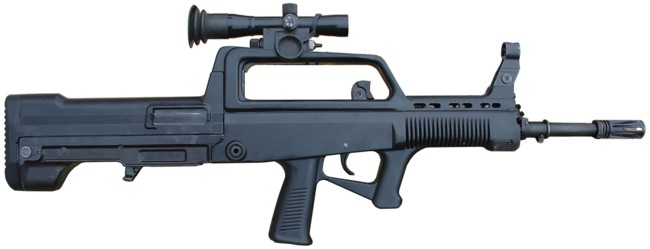
The QBZ-95 was first observed outside China in 1997, when the United Kingdom transferred the sovereignty of Hong Kong to the People's Republic of China. It is a modern weapon system in a bullpup configuration, where the weapon's action and magazine are located behind the grip and trigger assembly. The weapon was designed to replace the standard-issue Type 81 rifle, which was similar in design to the AK-47 series.
The rifle uses modern synthetic materials in its construction, fires a 5.8x42mm small-caliber high-velocity bullet (in a class with the NATO standard 5.56x45mm SS109 and the Russian 5.45x39mm), and employs a bullpup configuration like the British SA80, French FAMAS, Austrian Steyr AUG, and Belgian F2000.

AUG A3

Type
Assault rifle


Place of origin  Austria
Cartridge
  • 5.56x45mm NATO
Action Gas-operated, rotating bolt
Rate of fire 680-750 rounds/min
Muzzle velocity Standard rifle: 970 m/s (3,182 ft/s)
Effective range 300 metres (980 ft)
Maximum range 2,700 metres (8,900 ft)
Feed system
  • 5.56x45mm NATO: 30 or 42-round box magazine, Beta C-Mag
Sights  battle sights


The quick-change barrel used in the AUG is cold hammer-forged by GFM-GmbH of Steyr Austria for increased precision and durability, its bore, chamber and certain components of the gas system are chrome-plated. The standard rifle-length barrel features 6 right-hand grooves and a rifling twist rate of 228 mm (1:9 in). An external sleeve is shrunk on to the barrel and carries the gas port and cylinder, gas valve and forward grip hinge jaw. There is a short cylinder which contains a piston and its associated return spring. The barrel locks into a steel insert inside the receiver through a system of eight lugs arranged around the chamber end and is equipped with a folding, vertical grip that helps to pivot and withdraw the barrel during barrel changes. The most compact of the barrels has a fixed vertical grip.
The receiver housing is a steel-reinforced aluminum extrusion finished with a baked enamel coating. It holds the steel bearings for the barrel lugs and the guide rods. The non-reciprocating plastic cocking handle works in a slot on the left side of the receiver and is connected with the bolt carrier's left guide rod. The cocking handle has a forward assist feature—alternatively called a "silent cocking device"—used for pushing the bolt shut without recocking the rifle. A bolt hold-open device locks the bolt carrier assembly back after the last round has been fired. The AUG lacks a bolt release button, and the cocking handle must be retracted to release the bolt group after a new magazine has been inserted.
The rifle’s stock is made from fiberglass-reinforced polyamide 66. At the forward end is the pistol grip with an enlarged forward trigger guard completely enclosing the firing hand that allows the rifle to be operated with winter gloves.The trigger is hung permanently on the pistol grip, together with its two operating rods which run in guides past the magazine housing. Behind that is the locking catch for the stock group. Pressing this to the right will separate the receiver and stock. The magazine catch is behind the housing, on the underside of the stock. Above the housing are the two ejector openings, one of which is always covered by a removable strip of plastic. The rear of the stock forms the actual shoulder rest which contains the hammer unit and the end of the bolt path. The butt is closed by an endplate which is held in place by the rear sling swivel. This swivel is attached to a pin which pushes in across the butt and secures the plate.


CZ 805


 Caliber: 5.56x45 mm NATO, 7.62x39 M43 interchangeable; also 6.8x43 Rem SPC proposed in near future
Action: Gas operated, rotating bolt
Overall length: 910 mm (butt extended)
Barrel length: 360 mm standard, other lengths available
Weight: 3.6 kg less magazine and accessories
Rate of fire: ~ 700 rounds per minute
Magazine capacity: 20, 30 or 100 rounds


The CZ 805 assault rifle was first introduced to the public in 2009, as a possible future replacement for aged Sa. Vz. 58 assault rifles still in use by Czech armed forces. According to the recent news, early in 2010 the CZ 805 was selected as a next standard military rifle for Czech armed forces, with production contract issued to the famous Czech arms factory CZ-UB in the city of Uhersky Brod. It is quite possible that CZ 805 rifles also will be offered for export, either in military (select-fire) or in civilian (semi-automatic only) versions.
The CZ 805 (which is apparently dubbed as "CZ 805 BREN A1" in Czech sources) is a modular weapon of modern appearance. In its layout it is somewhat similar to the Belgian FN SCAR assault rifle (against which CZ 805 competed and won in Czech army trials), but similarity is not exact and there are significant design differences between these two weapon systems.
The CZ 805 assault rifle is of modular, multi-caliber design, with aluminum alloy upper receiver and polymer lower receiver / fire control unit. The magazine housing is a separate detachable unit, which can be replaced in the field in the course of caliber change. CZ 805 also features quick-change barrels, allowing to change calibers and barrel lengths according to the mission profile (in each caliber there there are short carbine barrel, standard barrel and long "marksman" or "squad automatic" barrel). The basic action uses fairy common piston-operated gas action with manual gas regulator, and a rotating bolt locking. For each proposed caliber, there is a separate bolt with appropriate dimensions.
Fire control unit includes ambidextrous safety / fire selector switch, which permits single shots, 2-round bursts and full automatic fire. Charging handle can be installed on either side of the gun, depending on user preferences.
Feed is from detachable box magazines, which are inserted into detachable magazine housing. In standard configuration, the CZ 805 will use proprietary 5.56x45 caliber 30-round magazines made of translucent polymer. Other magazine housings will allow use of STANAG or HK G36 5.56mm magazines, as well as various 7.62x39 and 6.8x43 magazines.
 CZ 805 assault rifle is fitted with integral Picatinny rail on the top of receiver, with additional rails running on the sides and the bottom of the forend. Rifle will be issued with folding iron sights, and will also accept a wide variety of additional sighting equipment (red-dot or telescope day sights, night sights, lasers etc). Rifle is equipped with side-folding buttstock, which is adjustable for length of pull, and can be completely removed if maximum compactness is required. Additional equipment also includes new, specially designed 40mm underbarrel grenade launcher CZ G 805 and also a new knife-bayonet.

Wednesday, September 14, 2011

BERETTA ARX 160


Type
  • Assault rifle
  • Battle rifle (6.8 mm Remington SPC, 7.62x39mm Soviet)
Place of origin  Italy
Used by See Users
Wars War in Afghanistan
Manufacturer Beretta
Variants ARX 160SF
Weight 3.1 kg (6.8 lb) (empty with 406 mm barrel)
3.0 kg (6.6 lb) (empty with 302 mm barrel)

Length 755 mm (29.72 in) (stock exteneded w. 302 mm barrel)
680 mm (26.77 in) (stock collapsed w. 302 mm barrel)

Barrel length 302 mm (11.89 in)
406 mm (15.98 in)

Cartridge 5.56x45mm NATO, 5.45x39mm Soviet, 6.8 mm Remington SPC, 7.62x39mm Soviet
Action Gas-operated rotating bolt
Rate of fire 700 RPM
Effective range 5 position rear sight up to 600 m (656 yd)
Feed system 30 round STANAG Magazine, 100-round C-Mag drum magazine
Sights Front sight adjustable in elevation and windage

The ARX-160 is an assault rifle manufactured by Pietro Beretta S.p.A.. Developed for the Italian armed forces as part of the Soldato Futuro (Future Soldier in English) program, the ARX-160 has been launched in the year 2008 as a commercial weapon system independent from the Soldato Futuro ensemble, complete with a companion single-shot 40mm NATO low-velocity grenade launcher, called GLX-160, which can be underslung to the rifle or used with an ad-hoc stock system as a stand-alone weapon. The ARX-160 departs from the previously issued Beretta 70/90 weapon system under several points of view. The weapon is composed of two receivers, both manufactured mostly in polymer, and operates through a short-stroke piston system. Feeding is through STANAG magazines.

HK 416


Type Assault Rifle
Place of origin  Germany

In service 2005–present
Used by See Users
Wars War in Afghanistan, Iraq War

Designer Ernst Mauch
Manufacturer Heckler & Koch
Produced 2005–present
Variants D10RS, D14.5RS, D16.5RS, D20RS, HK416C, MR223, HK417, M27 Infantry Automatic Rifle


Weight HK416: 3.020 kg (6.66 lb)
Length HK416: 797 mm (31.4 in) stock extended / 701 mm (27.6 in) stock collapsed
Barrel length HK416: 264 mm (10.4 in)
Width 78 mm (3.1 in)
Height HK416: 240 mm (9.4 in)

Cartridge 5.56x45mm NATO
Action Gas-operated, rotating bolt
Rate of fire 700-900 rounds/min (cyclic)
Muzzle velocity Varies by barrel length and type of round used.
Feed system 20, 30-round STANAG magazine or 100-round Beta C-Mag
Sights Rear rotary diopter sight and front post, Picatinny rail

The HK416 (5.56 mm) was developed by Heckler & Koch for U.S. special operations forces as a major product improvement of M4/M16-type carbines and rifles. Using the HK-proprietary gas piston system found on the G36, the HK416 does not introduce propellant gases and carbon fouling back into the weapon’s interior, making it the most reliable of any M4/M16 type weapon.
The HK416 has been combat-proven in Southwest Asia and has also gained the attention of military, law enforcement, and security users outside of the US. In April 2007, the HK416 was selected as the new Norwegian Army rifle.
The origins of the HK416 began with the realization of the deficiencies of the direct gas impingement (gas tube) operating system found on conventional M4/M16-style weapons. Input from the users of current M4/M16-type arms, high-speed video assessment, and extensive live-fire testing in extreme operational environments such as the U.S. Army Desert Proving Ground in Yuma, Arizona revealed multiple areas for improvement.
Improvements were made to the internal operating system and miscellaneous component parts to improve reliability in best and worse case scenarios, with all types of ammunition, with all barrel lengths and with and without sound suppressors attached.
An innovative free-floating 4-quadrant rail system designed by HK allows all current accessories, sights, lights, and aimers used on M4/M16-type weapons to be fitted to the HK416. This HK rail system and can be installed and removed without tools.
The HK-proprietary gas system uses a piston driving an operating rod to control the function of the bolt, preventing propellant gases and the associated carbon fouling from entering the weapon’s interior. This increases the reliability of the weapon and extends the interval between stoppages. It also reduces operator cleaning time, heat transfer to the bolt and bolt carrier, and wear and tear on critical components.
To improve reliability, service life, and operator safety during obstructed bore occurrences or after extreme extended firing sessions, the HK416 uses barrels produced by Heckler & Koch’s famous cold hammer forging process.
The highest quality steel is used in this unique manufacturing process producing a barrel that provides superior accuracy for greater than 20,000 rounds with minimal degradation of accuracy and muzzle velocity. HK416 variants are available with 10.4, 14.5, 16.5, and 20 inch (264, 368, 419, 508 mm) barrels. Some HK416 variants also have “OTB” (Over-the-beach) capability and can be safely fired after being submerged in water and not completely drained.
In addition to the improvements in the baseline weapon, HK has produced a corrosion resistant steel magazine and a proprietary buffer to improve functional reliability.
An add-on single shot 40 x 46mm grenade launcher module can be quickly attached to the rail system of all models without tools. HK has applied its proven and fielded Safety Blank Firing Attachment and Live Round Excluder Magazine technology to the HK416, eliminating the possibility of live rounds being loaded into and fired through a standard issue weapon outfitted for blank firing only.
The HK416 is available as complete carbine or rifle or as a “drop-in” HK416 upper receiver module for use on the lower receivers of existing M4/M16 type weapons.


ACR MASADA


Type Assault Rifle
Place of origin  United States
Designer Magpul Industries
Designed 2006
Manufacturer Remington Arms, Bushmaster
Weight 3.175 kg (7.0 lb) (14.5" barrel no mag)
Barrel length 266-508 mm (10.5 to 18 in)

Cartridge Current: 5.56x45mm NATO
Future: 6.8 mm Remington SPC, 7.62x39mm
Action Gas-piston, rotating bolt
Rate of fire 800-950 RPM
Muzzle velocity 792-990 m/s (2600-3250 ft/s)
Effective range 300 m
Feed system 30-round detachable box (5.56 variant) magazine, staggered-column magazine (STANAG compatible)
Sights Rear: none included (Picatinny rail); front: integral flip-up, adjustable post

 
The Masada rifle was developed by US-based company Magpul Industries,which became famous for its line of aftermarket accessories and replacement parts for firearms. Work on the new modular rifle, suitable for civilian, police and military applications and designed more or less along the lines of the SCAR program commenced in 2006. First prototypes were shown to the public in 2007 at ShotShow, and early in 2008 it was announced that new rifle (previously known as Masada) willbe mass produced by famous American gun-making company Bushmaster Firearms. Current plans are to introduce civilian and police(semi-automatic) versions in mid-2009, with military select-fire version scheduled for production in late 2009. It is also planned to introduce Masada / BushmasterACR rifles in 5.56mm / .223 Rem caliber; other calibers might followlater. Magpul also is developing a 7.62x51 / .308 Win version of the Masada / ACR rifle, provisionally known as Masoud. It is still in early development and no information is available on its date of release to the public.
The Masada/ BushmasterACR rifle is gas operated, semi-automatic or selective-fired (Military version only) weapon of modular design. It utilizes aluminum allo yupper receiver, with polymer pistol grip / trigger / magazine housing(lower receiver) unit which is attached to the upper receiver using cross-pins. Various types of  lower receivers are planned to accommodate different types of magazines (i.e. Ar-15 type magazines as opposed to AK-type magazines). The trigger / manual safety unit is made as a single removable item, and it mostly utilizes Ar-15-compatible parts. The barrels of ACR / Masada are quick-detachable, with short-stroke gas pistons attached to each barrel. To remove the barrel(for change, inspection or maintenance), user has to remove polymer handguards, then swing down the wire lever, located below the barrel,turn the barrel to unlock and pull it forward and out of the receiver.All barrels are free-floated within handguards to achieve consistent accuracy. Bolt group also is made as a single unit, with captive return spring and rotary multi-lug bolt which locks directly to the barrel breech. The standard magazine housing, which is suited to accept Ar-15 type magazines, has ambidextrous magazine release buttons. The ambidextrous bolt stop release button is located at the front of the triggerguard. Safety lever is also ambidextrous, and charging handle can be installed on either side of the gun, depending on user preferences. Depending on the version (or user preferences) ACR /Masada rifle can be equipped with various Magpul-made buttstocks, fixedor side-folding, and adjustable for length of pull (some also with adjustable cheek rest). Each Masada/ BushmasterACR rifle gas integral Picatinny rail on the top of the receiver;additional accessory rails can be installed on forend according to user preferences. Masada / BushmasterACR rifle can be fitted with removable iron sights, and/or with any optical or night sight  with appropriate mounting.