Showing posts with label SUBMACHINE GUN. Show all posts

Wednesday, September 21, 2011

P90


Type Personal defense weapon
Place of origin Belgium
In service 1991–present
Used by 40+ countries (see Users)
Wars
  • Gulf War
  • Afghanistan War
  • Iraq War
  • Libyan Civil War
Designed 1986–90
Manufacturer FN Herstal
Produced 1990–present
Variants See Variants:
  • P90, P90 TR, P90 USG, P90 LV / IR
  • PS90, PS90 TR, PS90 USG
Weight
  • 2.54 kg (5.60 lb) empty
  • 2.68 kg (5.9 lb) empty magazine
  • 3.0 kg (6.6 lb) loaded magazine
Length 500 mm (19.7 in)
Barrel length 263 mm (10.4 in)
Width 55 mm (2.2 in)
Height 210 mm (8.3 in)
Cartridge FN 5.7×28mm
Action Straight blowback, closed bolt
Rate of fire 900 RPM (rounds per minute)
Muzzle velocity 715 m/s (2,350 ft/s)
Effective range 200 m (219 yd)
Maximum range 1,800 m (1,969 yd)
Feed system 50-round detachable box magazine
Sights Tritium-illuminated reflex sight, back-up iron sights

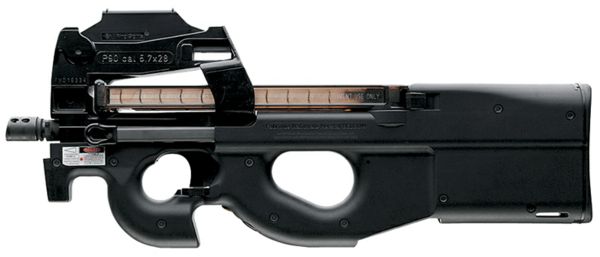
The FN P90 is a selective fire personal defense weapon (PDW) designed and manufactured by FN Herstal in Belgium. The P90's name is taken from 1990, the year it was introduced. The P90 was created in response to NATO requests for a replacement for 9×19mm Parabellum firearms; it was designed as a compact but powerful firearm for vehicle crews, operators of crew-served weapons, support personnel, special forces and counter-terrorist groups.
The P90 was designed by FN in conjunction with the FN Five-seven pistol and 5.7×28mm ammunition. Development of the P90 began in 1986, and production commenced in 1990, whereupon the 5.7×28mm ammunition was redesigned and shortened. A modified version of the P90 with a magazine adapted to use the new ammunition was introduced in 1993, and the Five-seven pistol was subsequently introduced as a companion weapon using the same 5.7×28mm ammunition.
The P90 was developed and initially marketed as a personal defense weapon, but it could also be considered a submachine gun or compact assault rifle. Featuring a compact bullpup design with an integrated reflex sight and fully ambidextrous controls, the P90 is an unconventional weapon with a futuristic appearance. Its design incorporates several innovations such as a unique top-mounted magazine and FN's small caliber, high velocity 5.7×28mm ammunition.
The P90 is currently in service with military and police forces in over 40 countries throughout the world. In the United States, the P90 is in use with over 200 law enforcement agencies, including the U.S. Secret Service.The standard P90 is restricted to military and law enforcement customers, but since 2005, a semi-automatic carbine version has been offered to civilian shooters as the PS90.


Friday, September 16, 2011

HK MP7


Type
  • Personal defense weapon
  • Submachine gun
  • Machine pistol
Place of origin  Germany
Used by 10+ countries (see users)
Wars
  • War in Afghanistan (2001–present)
Manufacturer Heckler & Koch
Produced 2001–present
Weight
  • 1.2 kg (2.65 lb) with 20 round empty magazine (PDW)
  • 1.9 kg (4.19 lb) without magazine (MP7A1)
Length 638 mm (25.1 in) stock extended / 415 mm (16.3 in) stock collapsed
Barrel length 180 mm (7.1 in)
Width 51 mm (2.0 in)
Height 169.5 mm (6.7 in)
Cartridge 4.6x30mm
Action Gas-operated, short stroke piston, rotating bolt
Rate of fire 950 rounds/min
Muzzle velocity 735 m/s (2,411 ft/s)
Effective range 200 m
Feed system 20 or 40 round box magazine
Sights Tritium-illuminated flip-up night sights; handgun and rifle sights


The MP7 is a German submachine gun manufactured by Heckler & Koch (H&K) and chambered for the 4.6x30mm cartridge. It was designed with the new cartridge to meet NATO requirements published in 1989, as these requirements call for a personal defense weapon (PDW) class firearm, with a greater ability to defeat body armor than current weapons limited to conventional pistol cartridges. The MP7 went into production in 2001. It is a direct rival to the FN P90, also developed in response to NATO's requirement. The weapon has been revised since its introduction and the current production version is the MP7A1.
The proliferation of high-quality body armor has begun to make guns that fire pistol ammunition (such as HK's earlier MP5 submachine gun or USP pistol) ineffective. In response to this trend, HK designed the MP7 (along with the now cancelled UCP pistol, which uses the same ammunition) to penetrate body armor, but small enough to be used in place of either a pistol or a submachine gun. The MP7 essentially operates like a scaled-down assault rifle, with the same action as HK's G36, a short stroke piston. It fires a specially designed, armor-piercing round with a muzzle velocity nearly as high as that of the 5.56x45mm NATO cartridge used by many modern rifles. This ammunition is unique among submachine guns in that the bullet is made almost entirely of a hardened steel penetrator instead of softer copper or lead. The ammunition is virtually exclusive to the gun (save for the now cancelled H&K UCP and a planned variant of the Brügger & Thomet MP9) and also offers low recoil. VBR of Belgium produces a 4.6x30mm 2-part controlled fragmenting projectile that is claimed to increase the content of the permanent wound cavity and double the chance to hit a vital organ.Heckler & Koch claims that the CPS Black Tip ammunition made by Fiocchi has a muzzle energy of approximately 525 J, which would be comparable to 9x19mm Parabellum rounds. The round also has a small diameter (it can almost be described as a scaled down .223 Remington), allowing for high capacity in a very small magazine. The weapon allows a conventional 20-round, 30-round, or 40-round box magazine to be fit within the pistol grip (the 20-round magazine being comparable in size to a 15-round 9 mm magazine, while the 40-round magazine compares to a 30-round 9 mm magazine). The weapon features an ambidextrous fire-select lever and rear cocking grip. It has an extendable stock and a folding front grip; it can be fired either one-handed or two-handed. It is compact and light, due to the use of polymers in its construction.


KRISS S-VECTOR


Type Submachine gun
Place of origin  United States
Designed 2006
Manufacturer KRISS USA, Inc., formerly Transformational Defense Industries
Produced 2009-present
Weight 5.6 lb (2.5 kg)

Length 24.3 in (620 mm)
16 in (410 mm) w/stock folded
Barrel length 5.5 in (140 mm)
Cartridge .45 ACP
, .40 S&W, 9x19mm Parabellum
Action Delayed Blowback, closed bolt
Rate of fire SMG: 1100-1200 rounds per minute
Civilian models: semi-auto only
Effective range ~100 m
Feed system 13-round detachable box magazine
30 rounds w/optional extension
Sights Flip-up iron
MIL-STD-1913 rail provided for optics

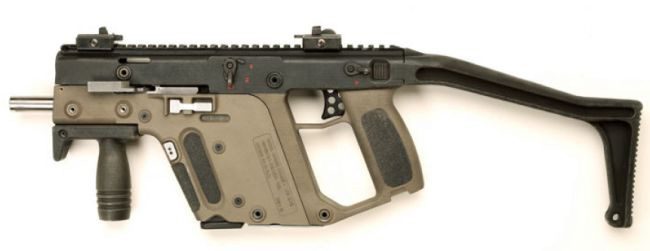
The KRISS Vector series is a family of NFA and non-NFA weapons based upon the parent submachine gun design developed by KRISS USA. KRISS USA is formerly known as Transformational Defense Industries (TDI). The KRISS VECTOR is unique in that it utilizes an asymmetrical recoil and in-line design to reduce recoil and muzzle climb. The Vector's action was originally developed by French engineer Renaud Kerbrat. This action, the so-called Kriss Super V, is an articulated mechanism which allows the block and bolt to recoil not just rearward like most other firearms, but back and then 'vectored' down off-axis along a rail system behind the weapon's magazine well. The Vector family of weapons is the first to use this action; the company claims the .45 ACP chambering was chosen to demonstrate that the action could "tame" such a powerful round. Variants chambered for the .40 S&W and 9x19mm Parabellum round are currently in development. All KRISS Vectors operate with standard Glock magazines with the .45 ACP caliber weapons using the 13 round G-21 magazine.
The Vector's barrel is in line with the shooter's shoulder as in the M16 rifle and German FG42, but also in line with the shooter's hand as with many target pistols. Combined, these factors reduce felt recoil and muzzle climb by eliminating the distance between the shooter's hand and the bore axis along with the action of the Super V Mechanism.


HK UMP


Type Submachine gun
Place of origin  Germany
Designed 1990s
Manufacturer Heckler & Koch
Produced 1999-present
Weight 2.3 kg (5 lb) without magazine (UMP45)
2.1 kg (4.6 lb) without magazine (UMP40, UMP9)
Length 450 mm (17.7 in), stock folded
690 mm (27.2 in), stock extended
Barrel length 200 mm (8 in)

Cartridge .45 ACP (UMP45)
.40 S&W (UMP40)
9x19mm Parabellum (UMP9)
Action Recoil, closed bolt
Rate of fire 650 rounds/min (UMP9; UMP40)
600 rounds/min (UMP45)
Effective range 100 m (9x19mm Parabellum), 50 m (.45 ACP)
Feed system 25-round detachable box magazine (UMP45), 30-round detachable box magazine (UMP40, UMP9)

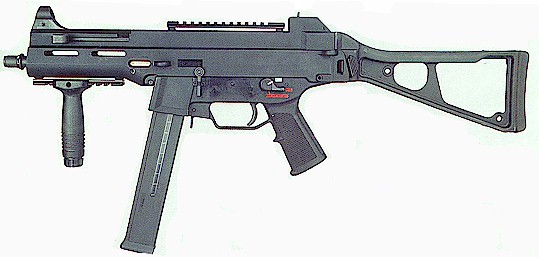
The UMP is a recoil-operated, magazine-fed submachine gun firing from a closed bolt. As originally designed, the UMP is chambered for larger cartridges than other submachine guns like the MP5, to provide more stopping power against unarmored targets (with a slightly lower effective range) than the 9x19mm MP5 provides. A larger cartridge produces more recoil, and makes control more difficult in fully automatic firing. To mitigate this, the cyclic rate of fire was reduced to 650 rounds/min (600 rounds/min for the UMP45), which makes it one of the slower firing submachine guns on the market.
The UMP9 (the 9x19mm version of the UMP) is almost 0.45 kg (almost 1 lb) lighter than its MP5 counterpart. Its predominantly polymer construction reduces both its weight and the number of parts susceptible to corrosion.
The UMP is available in four trigger group configurations, featuring different combinations of semi-automatic, 2-round burst, fully automatic, and safe settings. It features a side-folding buttstock to reduce its length during transport. When the last round of the UMP is fired, the bolt locks open, and can be released via a catch on the left side. The standard viewing sights comprise an aperture rear sight and a front ring with a vertical post. It can mount four Picatinny rails (one on top of the receiver, and one on the right, left, and the bottom of the handguard) for the attachment of accessories such as optical sights, flashlights, or laser sights. Vertical foregrips can be attached to the bottom rail for increased controllability during burst and automatic fire.


Wednesday, September 14, 2011

MAGPUL FMG


Type Submachine gun
Place of origin  United States
Designed 2008
Manufacturer Magpul Industries
Weight 0.5 kg (1.1 lb)
Length 503 mm (19.8 in) (extended)
262 mm (10.3 in) (folded)
Cartridge 9x19mm Parabellum
Action Blowback
Feed system 32-round box magazine

The Magpul FMG-9 is a prototype for a new generation of folding submachine guns, designed by Magpul Industries in 2008. Like other folding machine guns, it would be used for concealed carry and can be disguised as anything from a small package to an extra laptop battery. It is made out of a light-weight polymer material rather than metal, making it very light and easy to carry. It is also small enough even to fit in the back pocket of most everyday pants. It was developed for potential use by personal protection details such as the United States Secret Service. It is still a prototype and may or may not be made in large numbers for law enforcement agencies. The prototype uses a semi-automatic firing mechanism from a 9mm Glock 17 pistol. With modification, the FMG-9 could also use the mechanism of a Glock 18 machine pistol for Class 3 or law enforcement use.